
Why we don't have standard projects
When someone asks what we actually do at erminas, the answer is rarely short. One week it’s machine data from a production hall, the next it’s business processes in an ERP system, and in between there’s a research project with a university.
Some IT companies have a clear focus: web stores, ERP support or app development. That’s not a bad thing – but it also means that a lot of things are repeated.
It’s different for us. We work with industrial companies that want to network their machines. We develop solutions for complex business processes. We build our own products. And sometimes we conduct joint research with universities on topics that don’t even exist yet.
For you as an apprentice, this means that you don’t always know on Monday what you’ll be working with on Friday. In the best sense of the word.
The areas in which we work
To give you a feeling, here is an overview – not a complete list, but a snapshot of what is currently happening or has happened in recent years.
Industrial IoT: When machines start talking
A large part of our work revolves around the Industrial Internet of Things. Put simply, we help companies to obtain data from their production facilities and use it sensibly.
It sounds abstract, but it quickly becomes concrete. A sensor on a machine records temperature, pressure or vibration. This data has to go somewhere, be processed and displayed. In the end, someone in production should be able to see at a glance whether everything is running smoothly or whether a problem is looming.
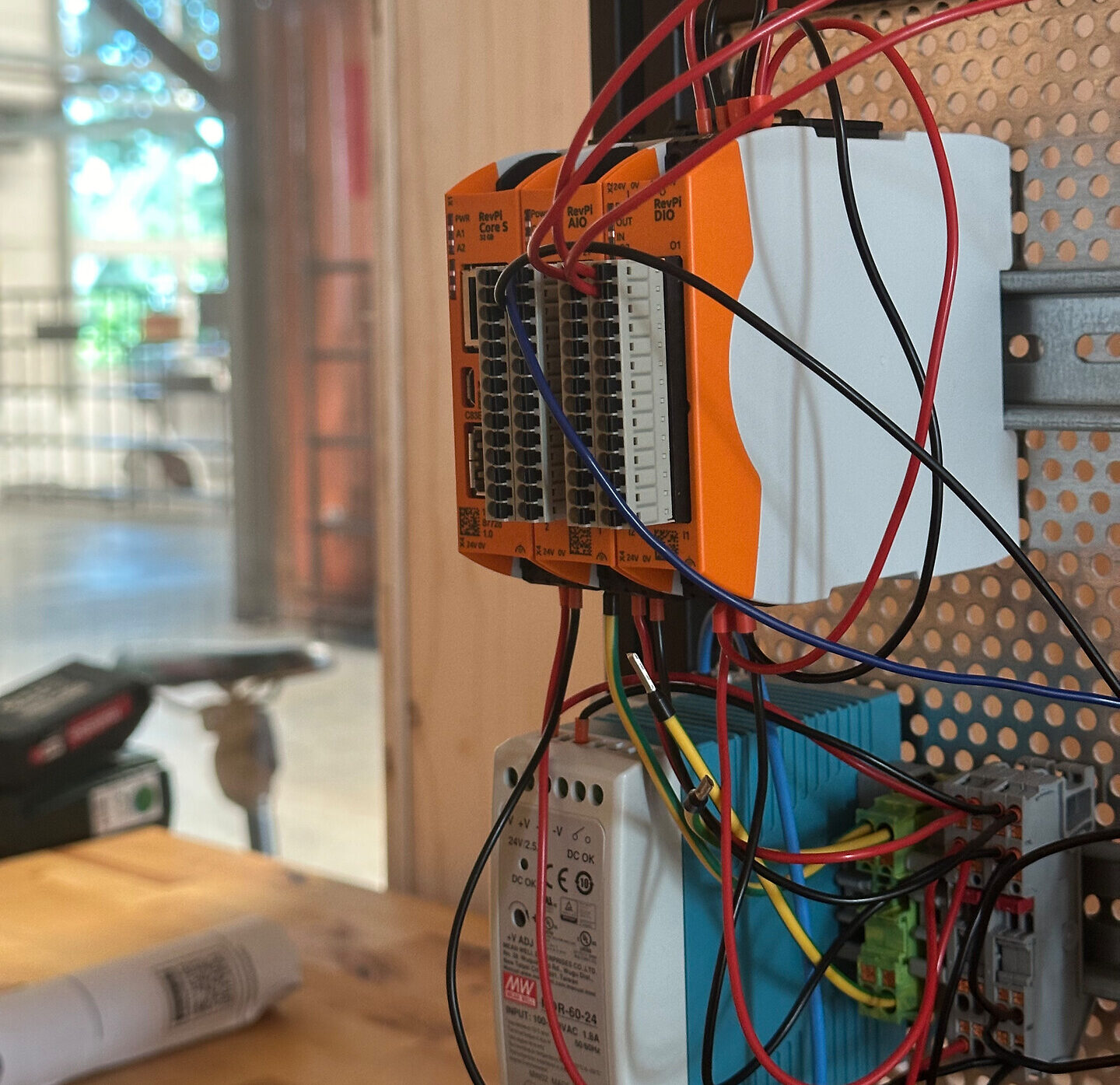
As an apprentice, you will come into contact with topics that are often missing from traditional IT training: Edge devices and industrial protocols, time series databases and real-time processing, dashboards for the store floor. And the constant challenge of bringing IT systems and the world of production together.
You quickly learn that the real world doesn’t always work as cleanly as a tutorial. Machines are old, protocols are proprietary and the hall has no WLAN. That’s exactly what makes it interesting.
Business Central: Understanding and mapping business processes
Microsoft Dynamics 365 Business Central is an ERP system for SMEs. ERP stands for Enterprise Resource Planning – in other words, the software in which a company manages its orders, writes invoices, maintains stock levels and does its accounting.
We adapt Business Central to the needs of our customers: developing new functions, building interfaces to other systems, optimizing existing processes.
This is an exciting field for training because you learn two things at the same time. Technically, you work with the AL programming language, develop within a large framework and learn how to deal with data structures and business logic. Professionally, you understand how a company actually works: What happens between order and delivery? Why is accounting complicated?
This understanding of business processes is something that many developers never really learn. Here you get it along the way.
Own products: erPub and erTrace
Not everything we do is a customer order. We also develop our own products, which we sell and develop further ourselves.
erPub is a solution for technical documentation. Companies use it to create and manage instructions, manuals and documentation. It sounds unspectacular, but is technically demanding: versioning, multilingual content, various output formats, integration into existing systems.
erTrace comes from the IIoT sector and is used for traceability in production. Which component came from where and when? Which parameters were used during production? Such questions are essential for industries such as automotive or medical technology.
Working on your own products has a special appeal. You see how a product grows over a long period of time. You experience decisions that don’t just apply to one project, but have to be sustainable in the long term. And you realize that behind every feature there are real users who work with it.
Research projects: When there is no solution yet
We regularly work on research projects, often in collaboration with universities – currently with Helmut Schmidt University in Hamburg, for example.
Research projects are very different from normal project business. There is no ready-made requirement that has to be implemented. Instead, it’s about trying something out, testing hypotheses, breaking new ground. This could be virtual reality, which is used in industrial contexts, new approaches to human-machine interaction or concepts that do not yet have a name.
Such projects are special opportunities for trainees. Not because you become a VR specialist afterwards – but because you experience what it feels like when there is no Stack Overflow contribution to your own question. This teaches you a kind of problem-solving that you don’t learn in routine projects.
Web, cloud and the tools of the trade
Of course, we also do classic web development and cloud projects. Building APIs, developing front ends, operating systems in Azure. This is part of the trade and often forms the basis for the more specialized topics.
Here you will learn front-end development with modern frameworks, back-end development with .NET, database design and SQL, cloud services and infrastructure as well as professional workflows with Git and CI/CD. You will need these basics in practically every area – they are the foundation on which everything else is built.
Why diversity is the best teacher
If you read the training regulations for IT specialists, everything sounds very structured. Certain content in certain time periods, exams on fixed topics.
The reality with us is somewhat different. Of course you fulfill all the formal requirements. But beyond that, there’s a lot going on that isn’t part of the curriculum.
You learn to familiarize yourself with new things. This is perhaps the most important skill in IT of all. Technologies change, projects present new challenges, and nobody can know everything. The best way to develop this skill is to do it again and again. With us, you will regularly be confronted with topics that you do not yet know. This can be frustrating – but it’s the best training effect.
You see different approaches. Every area has its own culture. IoT projects tick differently than ERP implementations. Product development follows different rhythms than customer projects. Research has its own rules. When you get to know different areas, you realize which methods work where. And you develop your own style, which is shaped by different influences.
You find out what interests you. At the beginning of your training, you probably don’t know exactly what direction you want to take. Maybe you have a vague idea – “something to do with programming” or “something to do with data”. The variety we offer gives you the chance to try out different things. Maybe you realize that business processes interest you more than expected. Or that technical documentation is more exciting than you thought. This trial and error leads to decisions based on real experience.
You become connectable. The IT industry is large and diverse. If you only get to know a small section during your training, you will not have an overview later on. With a broad basis, you will understand how different areas are connected. You can talk to different specialists on an equal footing. And you have options if you want to change direction at some point.
What this looks like in practice
Theory is one thing, everyday life is another.
Project changes instead of rigid departments: We don’t have an “IoT” department or an “ERP” department that you are put into and then stay in. Instead, we work on a project basis. Teams are formed according to requirements, and as an apprentice you rotate through different projects. One month you might be helping with a Business Central customization, the next with the development of an IoT dashboard, and then with a research topic.
Experienced colleagues as a point of contact: Every time you change projects, there is someone who looks after you – not in the sense of controlling you, but as a contact person for questions and feedback. You are never alone in an unfamiliar topic. This is important because diversity can quickly become overwhelming without support. We make sure that you never jump in at the deep end without a life preserver.
Sharing knowledge is part of the culture: when someone learns something new – be it a technology, a method or an insight from a project – it is shared. In team meetings, in internal wikis, in spontaneous conversations. As a trainee, you benefit from this in two ways: you gain knowledge that you would otherwise have to laboriously gather yourself. And you learn that sharing knowledge is part of the job.
What this means for your future
At some point, the training is over. What comes next depends on many factors – including what you have learned during these years.
After your training, you will have an overview of different areas. You know what suits you and what interests you. On this basis, you can specialize in a targeted manner – with the advantage that you still understand the other areas. Whether you develop in the direction of IIoT, ERP, cloud architecture or something completely different: the foundation is solid.
In addition, adaptability is a career advantage. The IT sector is changing rapidly. What is in demand today may be outdated tomorrow. Those who have only focused on one thing during their training will then face a problem. On the other hand, those who have learned to familiarize themselves with new things and adopt different perspectives remain flexible.
Have we piqued your interest? We look forward to receiving your application.