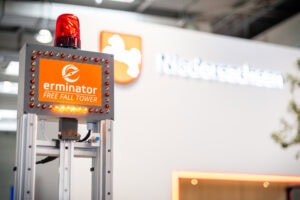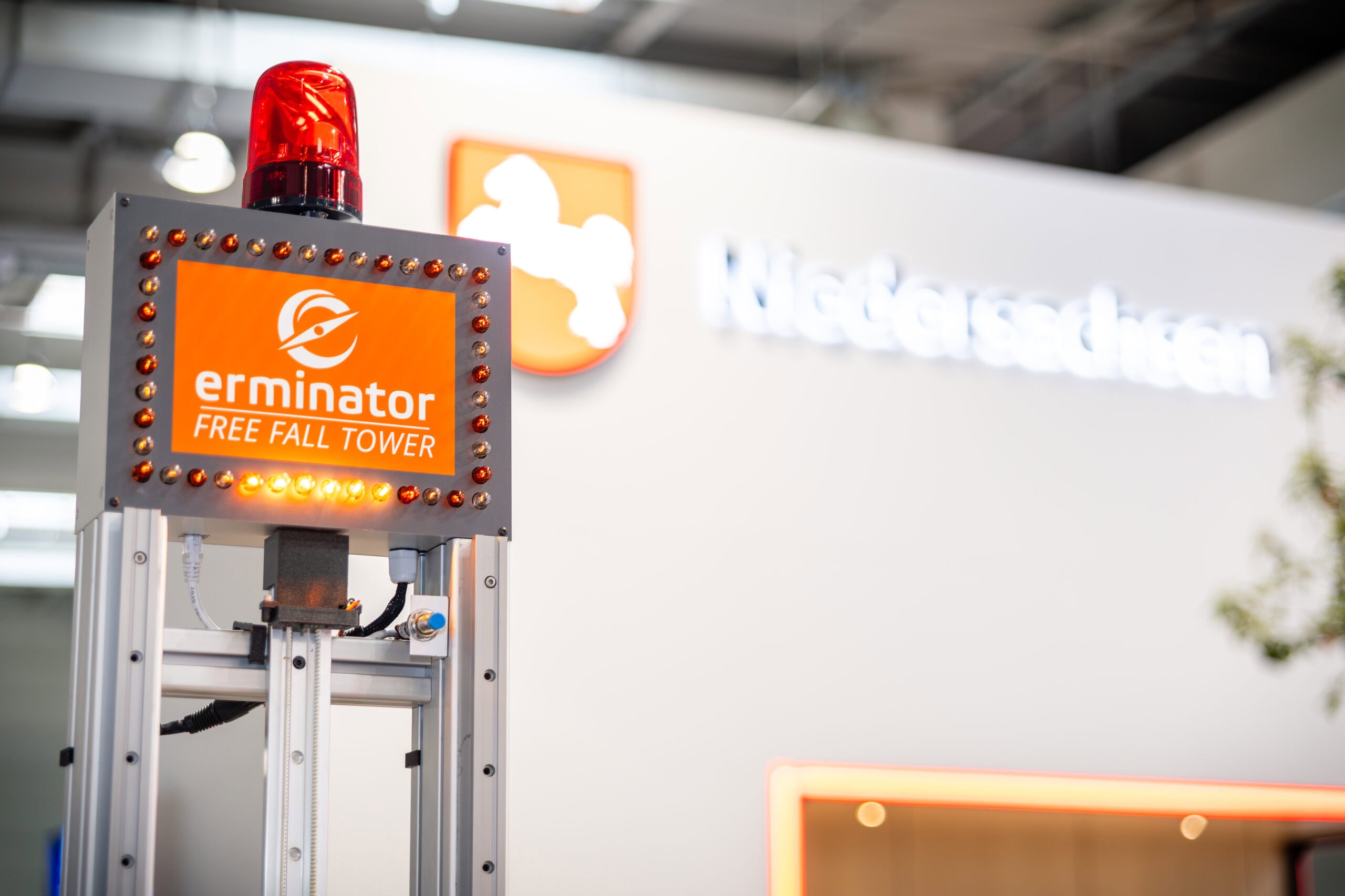

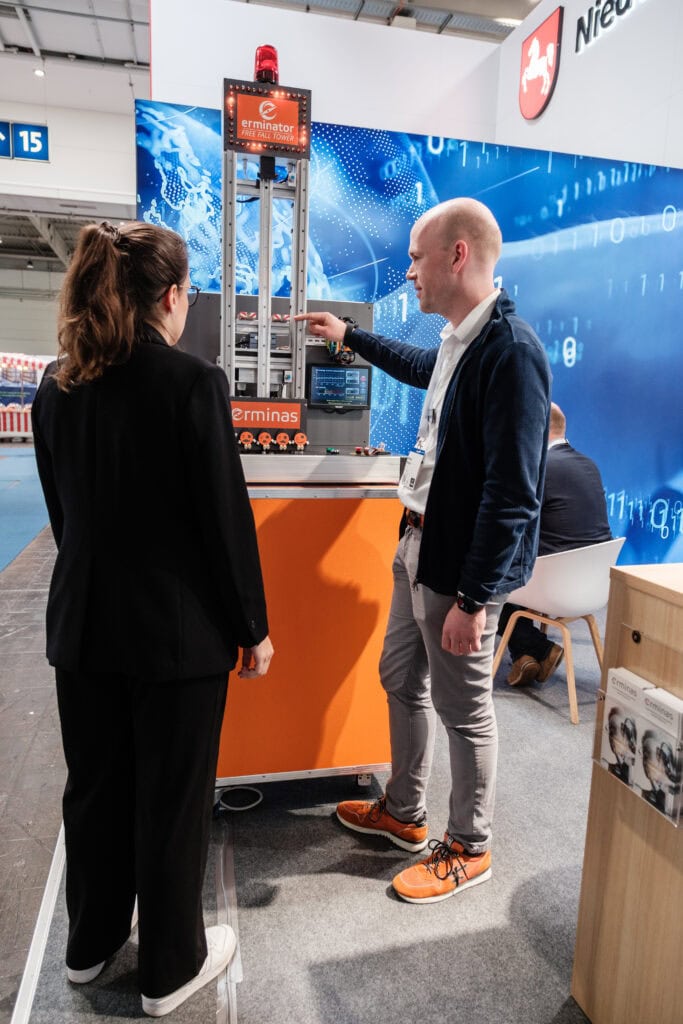
Industrial processes and software solutions usually remain invisible in everyday life – hidden in control cabinets, production lines or the cloud. At trade fairs, we bring this technology to the surface: our freefall tower exhibit transfers industrial processes into a compact, vivid format and shows how hardware, control and software work together in real time.
The aim is to make industrial digitalization understandable and tangible – not in abstract terms, but as a concrete example of networked systems and automated processes.
1. components and structure of the exhibit
The Freefall Tower simulates industrial motion sequences on a reduced scale – from the start signal to controlled braking. Visitors can trigger various driving scenarios and observe how sensor data is recorded, processed and then passed on as maintenance information. This creates a vivid example of the entire path of industrial data: from recording and analysis to automated process triggering in Business Central.
This is technically implemented by two industrial edge computers of the type RevPi from Kunbus. The first computer controls the processes – it starts the journeys and activates the braking processes at the touch of a button. The second collects sensor data, evaluates it and visualizes the results on a connected display.
For comparable applications, we also rely on systems from other manufacturers, such as Siemens Industrial Edge, Beckhoff CX controllers or WAGO Edge Computing Modules. These platforms show how flexibly edge architectures can be integrated into existing automation and IT landscapes.
A central technical element of the Freefall Tower is the eddy current brake, which regulates the fall speed via a variable magnetic field. Sensors record the start and end points of each ride, the edge computer calculates the duration and speed and automatically detects deviations from the target behavior. This allows different operating states to be simulated – from normal travel to malfunction.
Three operating modes can be selected via buttons on the control panel:
Position 0: Normal travel without braking effect
Position 1: Slight fault, brake partially active
Position 2: Major fault, brake fully active – maintenance requirement is simulated
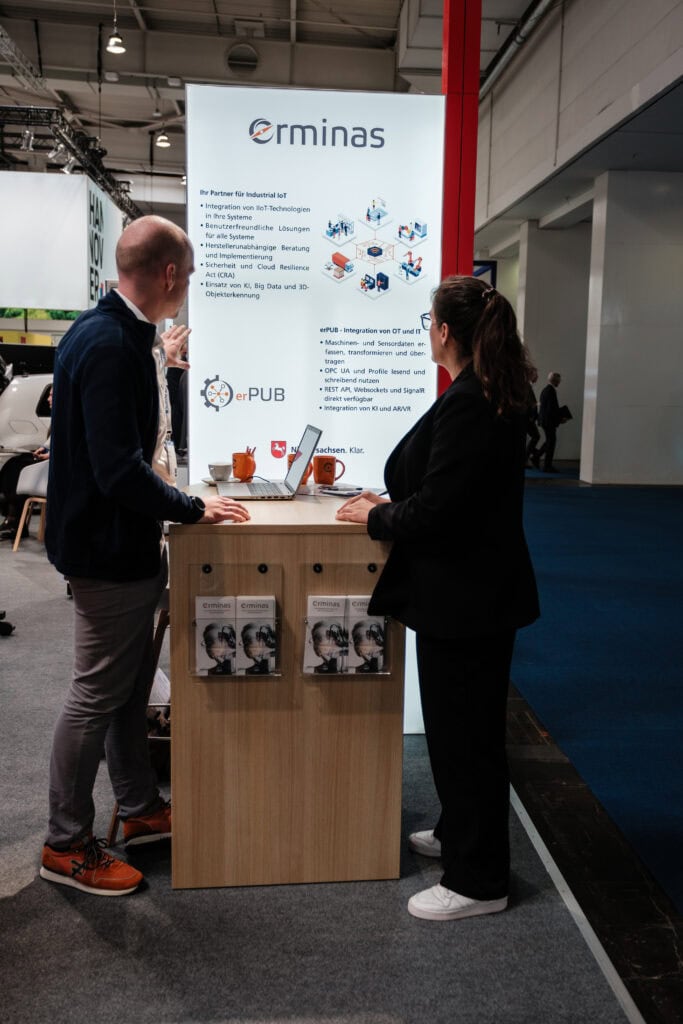
If a fault is detected, the integration of erPUB and Microsoft Dynamics 365 Business Central (BC) takes effect: Via an AL interface erPUB automatically triggers a maintenance order in the ERP system. This process can be tracked in real time on a separate tablet – from the triggering of the event to the entry of the order in BC.
The exhibit is a practical demonstration of how OT (operational technology) systems and IT systems can be linked to automate maintenance processes and make data flows transparent.
2. demonstration at trade fairs: Interactive experience
At trade fairs, the freefall tower serves as a demonstrator for real industrial use cases – such as predictive maintenance, automated maintenance processes and sensor data analysis. Visitors can use control elements to trigger specific faults and observe how these are recorded, evaluated and automatically transmitted to Business Central in the form of status data. This makes it clear how specific service orders are created from sensor data and how data-driven maintenance can be implemented in industrial environments.
The tablet display shows the automatically generated maintenance orders in Business Central, making it clear how status data is transferred to maintenance processes. This makes it clear how end-to-end integration of edge, IoT and ERP systems can be implemented in practice.
The exhibit thus illustrates the relevance of such integration scenarios: They enable more efficient fault detection, predictive maintenance and closer integration between production and business processes.
3. extensions and new connections
The Freefalltower exhibit is being continuously developed. Following the successful integration of erPUB and Business Central, the focus in future will be on expanded analysis and diagnostic structures. Additional sensors are conceivable in order to further increase data quality and condition monitoring, or AI-supported evaluations for early fault detection.
The combination of edge computing and process integration offers great potential for automation here. New interfaces – for example to MES, ERP or cloud systems – can further increase scalability and map real industrial scenarios even more precisely.
Exhibits such as the Freefall Tower not only attract attention at trade fairs, but also provide transferable use cases for industrial digitalization. They show how technical infrastructure, data analysis and business software can be combined to make maintenance and service processes more efficient and transparent.
The Freefall Tower is an example of how digitalization and industry can be efficiently combined. It demonstrates the practical integration of OT and IT – from sensor technology and edge computing to the ERP level – and illustrates the potential that lies in automated, data-based maintenance processes.
If you would like to find out what integration potential lies in your processes, please contact us – we will be happy to advise you on suitable solutions.